nuclear waste pumped out to sea by what countries?
From 1946 through 1993, thirteen countries used ocean disposal or ocean dumping as a method to dispose of nuclear/radioactive waste. The waste materials included both liquids and solids housed in diverse containers, as well every bit reactor vessels, with and without spent or damaged nuclear fuel.[ane] Since 1993, ocean disposal has been banned by international treaties. (London Convention (1972), Basel Convention, MARPOL 73/78)
"Ocean floor disposal" (or sub-seabed disposal)—a more deliberate method of delivering radioactive waste to the ocean floor and depositing it into the seabed—was studied by the United Kingdom and Sweden, but never implemented.[ii]
History [edit]
Information are from IAEA-TECDOC-1105,[1] pages 3–4.
- 1946 First dumping performance at Northeast Pacific Sea (about 80 km off the coast of California)
- 1957 Get-go IAEA Advisory Group Meeting on Radioactive Waste Disposal into the Sea
- 1958 First United nations Conference on the Police of the Sea (UNCLOS I)
- 1964 On the 21 April, a satellite failed carrying a SNAP-9A radiothermal generator. 17,000 Ci (630 TBq) plutonium metal fuel burned up.[iii]
- 1972 Adoption of the Convention on the Prevention of Marine Pollution by Dumping of Wastes and Other Matter (London Convention 1972)
- 1975 The London Convention 1972 entered into force (Prohibition of dumping of high level nuclear waste.)
- 1978 On the 24 January a satellite named Kosmos 954 failed. It was powered by a liquid sodium–potassium thermionic converter driven by a nuclear reactor containing effectually l kilograms (110 lb) of uranium-235.
- 1983 Moratorium on depression-level waste dumping
- 1988 Assessing the Bear upon of Deep Sea Disposal of Low-level Radioactive Waste product on Living Marine Resources. IAEA Technical Reports Series No. 288
- 1990 Estimation of Radiation Risks at Low Dose. IAEA-TECDOC-557
- 1993 Russia reported the dumping of high level nuclear waste including spent fuel past former USSR.
- 1994 (February twenty) Total prohibition of disposal at sea came into force
1946–1993 [edit]
Data are from IAEA-TECDOC-1105.[1] Summary of pages 27–120:
Disposal projects attempted to locate platonic dumping sites based on depth, stability and currents, and to treat, solidify and contain the waste. However, some dumping only involved diluting the waste product with surface water, or used containers that imploded at depth. Fifty-fifty containers that survived the pressure level could physically disuse over time.

Country total at the major site. SU: Soviet Union (39,243 TBq) and Russia (ii.8v TBq), GB: Britain (35,088 TBq), CH: Switzerland (four,419 TBq), Exist: Belgium (2,120 TBq). US: Usa of America (3,496 TBq), JP: Japan (15TBq), KR: South Korea (?TBq), NZ: New Zealand (1+TBq). France (354 TBq), Deutschland (0.two TBq), Italia (0.2 TBq), the Netherlands (336 TBq), and Sweden (3.2 TBq) are inside the GB marker.
The countries involved – listed in club of total contributions measured in TBq (TBq=1012 becquerel) – were the Soviet Union, the United Kingdom, Switzerland, the Usa, Belgium, France, the netherlands, Japan, Sweden, Russia, New Zealand, Germany, Italy and South korea. Together, they dumped a total of 85,100 TBq (85.1x10¹⁵ Bq) of radioactive waste at over 100 ocean sites, as measured in initial radioactivity at the time of dump.
For comparing:
- Global fallout of nuclear weapon tests – ii,566,087x1015 Bq.[4]
- 1986 Chernobyl disaster full release – 12,060x1015 Bq.[5]
- 2011 Fukushima Daiichi nuclear disaster, estimated total 340x1015 to 780x1015 Bq, with 80% falling into the Pacific Ocean.[6]
- Fukushima Daiichi nuclear constitute cooling water dumped (leaked) to the sea – TEPCO approximate iv.7x1015 Bq, Japanese Nuclear Safety Commission approximate 15x1015 Bq,[7] French Nuclear Safety Committee estimate 27x1015 Bq.[viii]
- Naturally occurring Potassium 40 in all oceans – fourteen,000,000x10fifteen Bq.[9]
- 1 container (cyberspace 400 kg) of vitrified high-level radioactive waste has an average radioactive decay of 4x10¹⁵ Bq (Max 45x1015 Bq).
| Country | dumped (unit TBq=1012 Bq) | menses | num of sites, book, etc.* | |||
|---|---|---|---|---|---|---|
| Chill | Atlantic | Pacific | Total | |||
 Soviet Matrimony Soviet Matrimony | 38,369 | 0 | 874 | 39,243 | 1959–1992[10] | Arctic 20 sites, 222,000 chiliad3 and reactor due west or w/o spent fuel; Pacific Ocean (mainly sea of Japan) 12 sites, 145,000 grand3 |
 Britain Britain | 0 | 35,088 | 0 | 35,088 | 1948–82 | NE Atlantic 15 sites, unknown number of containers, 74,052 tons and xviii sites off coast of British isles more than 9.4 TBq |
 Switzerland Switzerland | 0 | 4,419 | 0 | four,419 | 1969–1982 | NE Atlantic 3 sites, 7,420 containers, v,321 tons |
 USA USA | 0 | 2,942 | 554 | three,496 | 1946–70 | Mid/NW Atlantic (9), Gulf of United mexican states (ii) total 11 sites, 34,282 containers, unknown quantity; Mid/NE Pacific Bounding main, total of 18 sites, 56,261 containers, ? tones |
 Kingdom of belgium Kingdom of belgium | 0 | 2,120 | 0 | two,120 | 1960–1982 | NE Atlantic 6 sites, 55,324 containers, 23,100 tons |
 France France | 0 | 354 | 0 | 354 | 1967–1969 | NE Atlantic 2 sites, 46,396 containers, fourteen,300 tons |
 Netherlands Netherlands | 0 | 336 | 0 | 336 | 1967–1982 | NE Atlantic 4 sites, 28,428 containers, nineteen,200 tons |
 Japan Japan | 0 | 0 | 15.08 | fifteen.08 | 1955–1969 | South of Honshu, 6 sites 15 times, three,031 containers, 606,000 m3 |
 Sweden Sweden | 0 | three.2 | 0 | 3.two | 1959,61,69 | Baltic sea i site, 230 containers, 64 tons; NE Atlantic i site, 289.5 containers, 1,080 tons, |
 Russia Russia | 0.vii | 0 | 2.one | 2.viii | 1992–93 | Arctic 3,066 m3; Pacific Body of water 6,327 chiliad3 |
 New Zealand New Zealand | 0 | 0 | 1.04 | i.04 | 1954–1976 | East coast of New Zealand, 4 sites, 9 containers, 0.62 thousand3 |
 Federal republic of germany Federal republic of germany | 0 | 0.ii | 0 | 0.two | 1967 | NE Atlantic ane site once, 480 containers, 185 tons |
 Italy Italy | 0 | 0.2 | 0 | 0.2 | 1969 | NE Atlantic 1 site, 100 containers, 45 tons |
 Southward Korea Southward Korea | 0 | 0 | no information | 1968–1972 | Sea of Nippon, one site 5 times?, 115 container, 45 tons | |
| Total | 38,369 | 45,262 | 1,446 | 85,077 | Subtotal of all volume reported is 982,394 m3. | |
| *Some countries report the mass and volume of tending waste and some just tonnage. The US did non report tonnage or volume of 90,543 containers. | ||||||
Types of waste and packaging [edit]
Data are from IAEA-TECDOC-1105.[1] : 6–vii, 14
Liquid waste product [edit]
- unpackaged and diluted in surface waters
- contained in package but not solidified
Solid waste [edit]
- low level waste like resins, filters, material used for decontamination processes, etc., solidified with cement or bitumen and packaged in metal containers
- unpackaged solid waste product, mainly large parts of nuclear installations (steam generators, pumps, lids of reactor force per unit area vessels, etc.)
Reactor vessels [edit]
- without nuclear fuel
- containing damaged spent nuclear fuel solidified with polymer agent
- special container with damaged spent nuclear fuel (icebreaker Lenin by the erstwhile Soviet Union)
| Waste type | Atlantic | Pacific Ocean | Arctic | full | note |
|---|---|---|---|---|---|
| Reactors with spent fuel | Nothing | Nil | 36,876 | 36,876 | |
| Reactors w/o fuel | ane,221 | 166 | 143 | 1,530 | |
| Low level solid | 44,043 | 821 | 585 | 45,449 | |
| Depression level liquid | <0.001 | 459 | 765 | 1,223 | |
| Total | 45,264 | 1445 | 38,369 | 85,078 |
Dump sites [edit]
Data are from IAEA-TECDOC-1105.[ane] : 27–120
Arctic [edit]
Mainly at the east declension of Novaya Zemlya at Kara Sea and relatively small-scale proportion at Barents Ocean by the Soviet Union. Dumped at 20 sites from 1959 to 1992,[10] total of 222,000 grandthree including reactors and spent fuel.

Arctic Ocean dump sites of radioactive waste. SU: Soviet Union (38,369 TBq), RU: Russia (0.7 TBq), SE: Sweden.
Northward Atlantic [edit]
Dumping occurred from 1948 to 1982. The UK accounts for 78% of dumping in the Atlantic (35,088 TBq), followed by Switzerland (4,419 TBq), the United States (ii,924 TBq) and Belgium (ii,120 TBq). Sunken Soviet nuclear submarines are not included; encounter List of sunken nuclear submarines
There were 137,000 tonnes dumped by eight European countries. The United States reported neither tonnage nor volume for 34,282 containers.

B: Belgium (2,120 TBq), F: France (354 TBq), D: Germany (0.2 TBq), I: Italy (0.two TBq), N: holland (336 TBq), S: Sweden (3.2 TBq), C: Switzerland (4,419 TBq), G:United Kingdom (35,088 TBq), U.s.a.: United States (2,942 TBq), SU: Soviet Wedlock.
Pacific Ocean [edit]
The Soviet Union 874 TBq, The states 554 TBq, Japan 606.2 Tonnes, New Zealand i+ TBq. 751,000 chiliad3 was dumped by Nippon and the Soviet Matrimony. The United States reported neither tonnage nor book of 56,261 containers.
Dumping of contaminated h2o at the 2011 Fukushima nuclear blow (estimate 4,700–27,000 TBq) is not included.
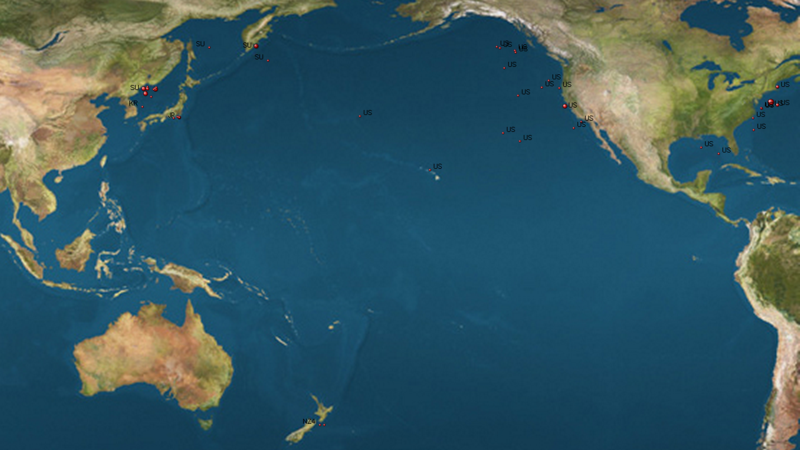
JP: Japan (15.1 TBq), KR: South korea (? TBq), NZ: New Zealand (1+ TBq), RU: Russian federation (2.one TBq), SU: Soviet Union (874 TBq), Us: United States (554 TBq)
Sea of Japan [edit]
The Soviet Union dumped 749 TBq. Nippon dumped 15.1 TBq south of master island. Republic of korea dumped 45 tonnes (unknown radioactivity value).

Dump sites in the Sea of Nippon. Sites off coast of Nakhodka are of the Soviet Spousal relationship and Russia.
Ecology impact [edit]
Data are from IAEA-TECDOC-1105.[1] : 7
Arctic Body of water [edit]
Joint Russian-Norwegian expeditions (1992–94) nerveless samples from 4 dump sites. At firsthand vicinity of waste containers, elevated levels of radionuclide were found, just had not contaminated the surrounding area.
North-East Atlantic Ocean [edit]
Dumping was undertaken by UK, Switzerland, Belgium, French republic, the Netherlands, Sweden, Germany and Italy. IAEA had been studying since 1977. The report of 1996, by CRESP suggests measurable leakages of radioactive cloth, and, concluded that environmental impact is negligible.
North-Due east Pacific Ocean, North-West Atlantic Ocean dump sites of USA [edit]
These sites are monitored past the United States Environmental Protection Agency and United states National Oceanic and Atmospheric Administration. So far, no excess level of radionuclides was institute in samples (sea water, sediments) collected in the expanse, except the sample taken at a location close to disposed packages that independent elevated levels of isotopes of caesium and plutonium.
North-W Pacific Ocean dump sites of the Soviet Union, Nihon, Russia, and Korea [edit]
The joint Japanese-Korean-Russian expedition (1994–95) ended that contamination resulted mainly from global fallout.
See too [edit]
- Horizontal drillhole disposal
- Ocean floor disposal
- Deep borehole disposal
- Yucca Mountain nuclear waste repository
- Waste product Isolation Pilot Constitute
- Grigory Pasko
- Nuclear fuel cycle
- Radioactive waste
- Great Lakes Basin § Nuclear power plants
- Decommissioning of Russian nuclear-powered vessels
References [edit]
- ^ a b c d e f IAEA TECDOC-1105 "Inventory of radioactive waste disposals at sea" August 1999 retrieved 2011-12-4
- ^ World Nuclear Clan "Storage and Disposal Options" retrieved 2011-11-14
- ^ Rääf, C; Holm, E; Rabesiranana, N; Garcia-Tenorio, R; Chamizo, E (2017). "On the presence of plutonium in Madagascar following the SNAP-9A satellite failure". J Environ Radioact. 177: 91–99. doi:10.1016/j.jenvrad.2017.06.011. PMID 28628779.
- ^ UNSCEAR "Exposures of the public and workers from diverse sources of radiations"
- ^ UNSCEAR "Wellness effects due to radiation from the Chernobyl accident"
- ^ Steinhauser, Georg; Brandl, Alexander; Johnson, Thomas East. (2014). "Comparing of the Chernobyl and Fukushima nuclear accidents: A review of the environmental impacts". Science of the Full Surround. 470–471: 800–817. Bibcode:2014ScTEn.470..800S. doi:10.1016/j.scitotenv.2013.10.029. PMID 24189103.
- ^ Japan Atomic Industrial Forum Inc(JAIF) "Earthquake-report 250 (thirty October 2011)" Archived 20 Dec 2011 at WebCite retrieved 2011-11-12
- ^ Mainichi Shimbun "Cesium-137 flow into bounding main 30 times greater than stated by TEPCO report (29 October 2011)" Archived 31 October 2011 at the Wayback Machine retrieved 2011-xi-12
- ^ Idaho State University "Radiation Information Network's Radioactivity in Nature"
- ^ a b Although the USSR dissolved in 1991, IAEA reported dumping of USSR in 1992.
piotrowskiquinnow.blogspot.com
Source: https://en.wikipedia.org/wiki/Ocean_disposal_of_radioactive_waste
0 Response to "nuclear waste pumped out to sea by what countries?"
Post a Comment