according to the chart in your textbook. what are the years of the renaissance?
What was it and when did it brainstorm?
The Smashing Proletarian Cultural Revolution was a decade-long period of political and social chaos caused by Mao Zedong's bid to use the Chinese masses to reassert his control over the Communist party.
Its bewildering complication and almost unfathomable brutality was such that to this day historians struggle to make sense of everything that occurred during the catamenia.
However, Mao's decision to launch the "revolution" in May 1966 is at present widely interpreted as an effort to destroy his enemies by unleashing the people on the party and urging them to purify its ranks.
When the mass mobilisation kicked off party newspapers depicted it as an epochal struggle that would inject new life into the socialist crusade. "Similar the ruby sunday rising in the east, the unprecedented Great Proletarian Cultural Revolution is illuminating the country with its brilliant rays," i editorial read.
In fact, the Cultural Revolution crippled the economy, ruined millions of lives and thrust China into x years of turmoil, bloodshed, hunger and stagnation.
Gangs of students and Ruby-red Guards attacked people wearing "bourgeois clothes" on the street, "imperialist" signs were torn down and intellectuals and political party officials were murdered or driven to suicide.
After violence had run its encarmine course, the country's rulers conceded it had been a catastrophe that had brought nothing merely "grave disorder, damage and retrogression".
An official party reckoning described it as a catastrophe which had caused "the virtually severe setback and the heaviest losses suffered past the political party, the country, and the people since the founding of the People'southward Republic" in 1949.
Whose idea was it and what was the aim?
The Cultural Revolution was the brainchild of China's 'Great Helmsman', Chairman Mao Zedong.
Seventeen years later on his troops seized power, Mao saw his latest political campaign as a mode of reinvigorating the communist revolution by strengthening ideology and weeding out opponents.
"Our objective is to struggle against and trounce those persons in authorization who are taking the capitalist road... then every bit to facilitate the consolidation and evolution of the socialist system," one early directive stated.
Frank Dikötter, the author of a new volume on the period, says Mao hoped his movement would brand China the acme of the socialist universe and turn him into "the man who leads planet Earth into communism."
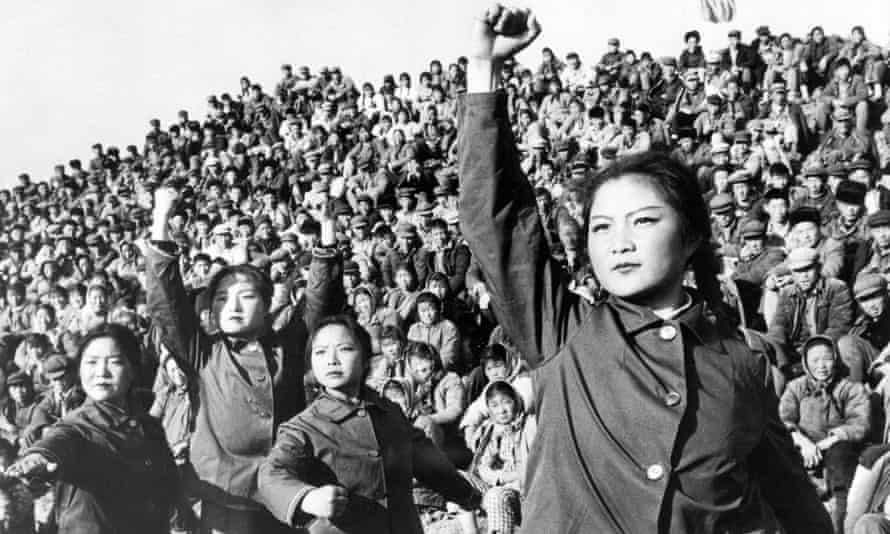
But it was as well an attempt by the elderly dictator, whose say-so had been desperately hit by the calamitous Great Famine of the 1950s, to reassert command over the political party by obliterating enemies, real or imagined.
"It was a ability struggle waged... backside the smokescreen of a fictitious mass movement," Belgian scholar Pierre Ryckmans wrote in his damning account of the Cultural Revolution, The Chairman'south New Dress.
How exactly did it starting time?
Virtually historians agree the Cultural Revolution began in mid-May 1966 when political party chiefs in Beijing issued a certificate known every bit the "May sixteen Notification". It warned that the party had been infiltrated by counter-revolutionary "revisionists" who were plotting to create a "dictatorship of the bourgeoisie".
A fortnight later on, on 1 June, the political party's official mouthpiece newspaper urged the masses to "clear away the evil habits of the old society" by launching an all-out assault on "monsters and demons".
Chinese students sprung into action, setting up Carmine Baby-sit divisions in classrooms and campuses beyond the country. By August 1966 - and then-chosen Carmine August - the mayhem was in total swing as Mao'due south allies urged Ruddy Guards to destroy the "iv olds" - one-time ideas, quondam community, old habits and quondam culture.
Schools and universities were closed and churches, shrines, libraries, shops and private homes ransacked or destroyed as the set on on "feudal" traditions began.
Gangs of teenagers in reddish armbands and armed forces fatigues roamed the streets of cities such equally Beijing and Shanghai setting upon those with "bourgeois" wearing apparel or reactionary haircuts. "Imperialist" street signs were torn down.
Political party officials, teachers and intellectuals besides found themselves in the cross-hairs: they were publicly humiliated, beaten and in some cases murdered or driven to suicide after vicious "struggle sessions". Claret flowed every bit Mao ordered security forces not to interfere in the Red Guards' work. Nearly i,800 people lost their lives in Beijing in August and September 1966 alone.
What happened next?
Afterwards the initial explosion of educatee-led "ruddy terror", the chaos spread rapidly. Workers joined the fray and China was plunged into what historians describe as a country of virtual civil war, with rival factions battling it out in cities beyond the state.
Past late 1968 Mao realised his revolution had spiralled out of control. In a bid to rein in the violence he issued instructions to transport millions of urban youth down to the countryside for "re-education".
He also ordered the army to restore order, effectively transforming China into a military dictatorship, which lasted until about 1971. Equally the ground forces fought to bring the situation under command, the death toll soared.
Betwixt 1971 and the Cultural Revolution's official end, in 1976, a semblance of normality returned to Cathay. United states of america president Richard Nixon even toured the country in February 1972 in a celebrated visit that re-established ties between Washington and Beijing.
It was, in Nixon's words, "the week that changed the world".
How many victims were there?
Historians believe somewhere between 500,000 and two million people lost their lives as a result of the Cultural Revolution.
Perhaps the worst affected region was the southern province of Guangxi where there were reports of mass killings and fifty-fifty cannibalism.
Appalling acts of barbarity also occurred in Inner Mongolia where authorities unleashed a fell entrada of torture against supposed separatists.
Even China's feline population suffered as Cherry-red Guards tried to eliminate what they claimed was a symbol of "bourgeois decadence". "Walking through the streets of the uppercase at the end of August [1966], people saw dead cats lying by the roadside with their front paws tied together," writes Dikötter.
Yet contrary to pop belief, the government was responsible for most of the mortality, non the Red Guards.
"We read a lot of horror stories nearly students chirapsia their teachers to death in the stairwell," says Andrew Walder, the author of China Nether Mao.
"[But] based on the regime's own published histories well over half, if not two-thirds of the people who were killed or imprisoned during the Cultural Revolution suffered that from 1968 to early 1970" equally the army moved in to halt the violence.
The lives of some of the Communist political party's nearly powerful figures were upended by the turbulence, including future leader Deng Xiaoping, who was purged in 1967, and Xi Zhongxun, the male parent of Communist china'south current president, Xi Jinping, who was publicly humiliated, beaten and sent into exile.
President Xi'south half-sister, Eleven Heping, is said to accept taken her own life afterward beingness persecuted.
How were foreigners affected?
Every bit anarchy enveloped Beijing in the summertime of 1966, foreign diplomats establish themselves at the eye of the tempest. "Earplugs became standard embassy issue," the former British ambassador Percy Cradock writes in his memoirs recalling how a cacophony of songs praising "our beloved Chairman Mao" became the soundtrack of life in the capital letter.
Past the post-obit year things had taken a more sinister turn. Red Guards laid siege to the Soviet, French and Indonesian embassies, torched the Mongolian administrator's car and hung a sign outside the British mission that read: "Crush British Imperialism!" Ane night, in late August, diplomats were forced to abscond from the British diplomatic mission as information technology was ransacked and burned. Outside protesters chanted: "Impale! Impale!".
Anthony Grey, a Reuters journalist in Beijing, spent more than two years in captivity after being detained by Chinese authorities in July 1967.
What was the Little Ruddy Book?
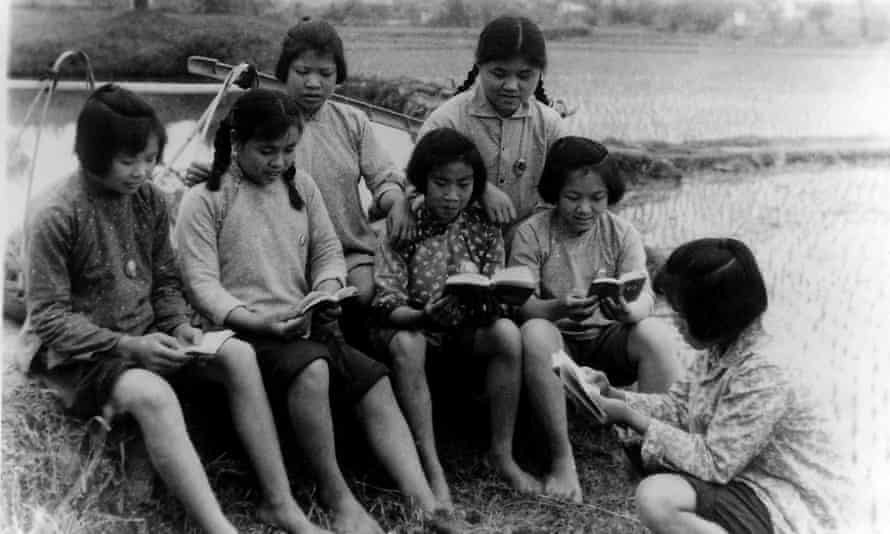
The Cultural Revolution's official handbook was the Piffling Reddish Book, a small drove of quotations from Mao that offered a blueprint for Ruddy Baby-sit life.
"Be resolute, fear no sacrifice, and surmount every difficulty to win victory!" read one famous counsel.
At the meridian of the Cultural Revolution, Lilliputian Red Book reading sessions were held on public buses and even in the skies to a higher place China, as air hostesses preached Mao'southward words of wisdom to their passengers. During the 1960s, the Little Ruby-red Book is said to have been the most printed volume on earth, with more a billion copies printed.
When did it stop?
The Cultural Revolution officially came to an cease when Mao died on 9 September 1976 at the age of 82.
In a bid to motility on - and avert discrediting Mao too much - party leaders ordered that the Chairman'due south widow, Jiang Qing, and a group of accomplices be publicly tried for masterminding the chaos. They were known every bit the "Gang of Four".
Jiang contested the charges claiming she had merely been "Chairman Mao's canis familiaris" merely was sentenced to decease in 1981, later on reduced to life in prison. In 1991, on the eve of the 25th anniversary of the Cultural Revolution, she hung herself.
How did the Cultural Revolution affect Cathay?
Mao had hoped his revolutionary motion would plow China into a beacon of communism. Simply 50 years on many believe it had the reverse issue, paving the mode for China'southward embrace of commercialism in the 1980s and its subsequent economical boom.
"A common verdict is: no Cultural Revolution, no economic reform," Roderick MacFarquhar and Michael Schoenhals write in their book on the period, Mao'southward Last Revolution. "The Cultural Revolution was then great a disaster that it provoked an even more profound cultural revolution, precisely the ane that Mao intended to forestall."
Another enduring legacy, experts say, is the obsession of today'southward rulers with stability and political control.
Leaders such as Xi Jinping, a 13-twelvemonth-old Beijing schoolboy when the cultural revolution began, had a front end row seat to the mayhem, and some even partook in the violence.
"They saw a China that was totally chaotic for virtually two years and they saw atrocities sometimes," says Walder, a Stanford University expert on the period. "They view the loss of the party'southward control equally something that volition lead to chaos."
Dikötter believes the nightmarish upheaval as well served to destroy any remaining organized religion the Chinese people had in their Great Instructor. "Even before Mao died, people cached Maoism."
How is the Cultural Revolution remembered today?
After Mao'southward death, the Communist party made some attempts to face up the horrors of the previous decade. Some were punished for the violence while those unfairly purged or persecuted were rehabilitated.
Just those efforts petered out in the early 1980s as Beijing became wary of implicating itself in the killing at a time of growing opposition from Chinese youth. Academics were discouraged from digging into the party'due south inconvenient truth.
Experts say Beijing would seek to mark this year'due south 50th anniversary with deafening silence.
"They won't go in that location - it is just likewise damaging to the party," says MacFarquhar. "The party is guilty of three massive blows to the Chinese people: the [Not bad] Famine, the Cultural Revolution and the destruction of the environment which is ongoing now and may in fact be more deadly that the other 2 in the long run. And the final thing information technology wants to say is that we were the guilty ones."
Still, a bitter public row over a Mao-themed extravaganza held in Beijing before this month has unexpectedly thrust the decade-long upheaval dorsum into the headlines.
What should I read to understand the Cultural Revolution?
The seminal piece of work on the flow is Mao'due south Last Revolution by Roderick MacFaquhuar and Michael Schoenhals, a accident-by-blow account of the turmoil.
An before volume by Schoenhals - China's Cultural Revolution, 1966-69: Not a Dinner Political party - contains a trove of documents, speeches and photographs, that chronicle the state'due south descent into anarchy.
Maybe the almost withering critique of the political mobilisation tin can be found in The Chairman's New Clothes: Mao and the Cultural Revolution, by Belgian scholar Pierre Ryckmans.
Ji Xianlin'south The Cowshed: Memories of the Chinese Cultural Revolution is a harrowing commencement-person account of the period. First published in 1998 and recently translated into English, the book recounts the hardship of a Peking Academy academic who spent about nine months every bit a prisoner of the Reddish Guards.
Another powerful Cultural Revolution memoir is Life and Death in Shanghai by Nien Cheng, a Chinese graduate of the London School of Economics whose life was turned upside down past the Ruby Guards in 1967.
piotrowskiquinnow.blogspot.com
Source: https://www.theguardian.com/world/2016/may/11/the-cultural-revolution-50-years-on-all-you-need-to-know-about-chinas-political-convulsion
0 Response to "according to the chart in your textbook. what are the years of the renaissance?"
Post a Comment